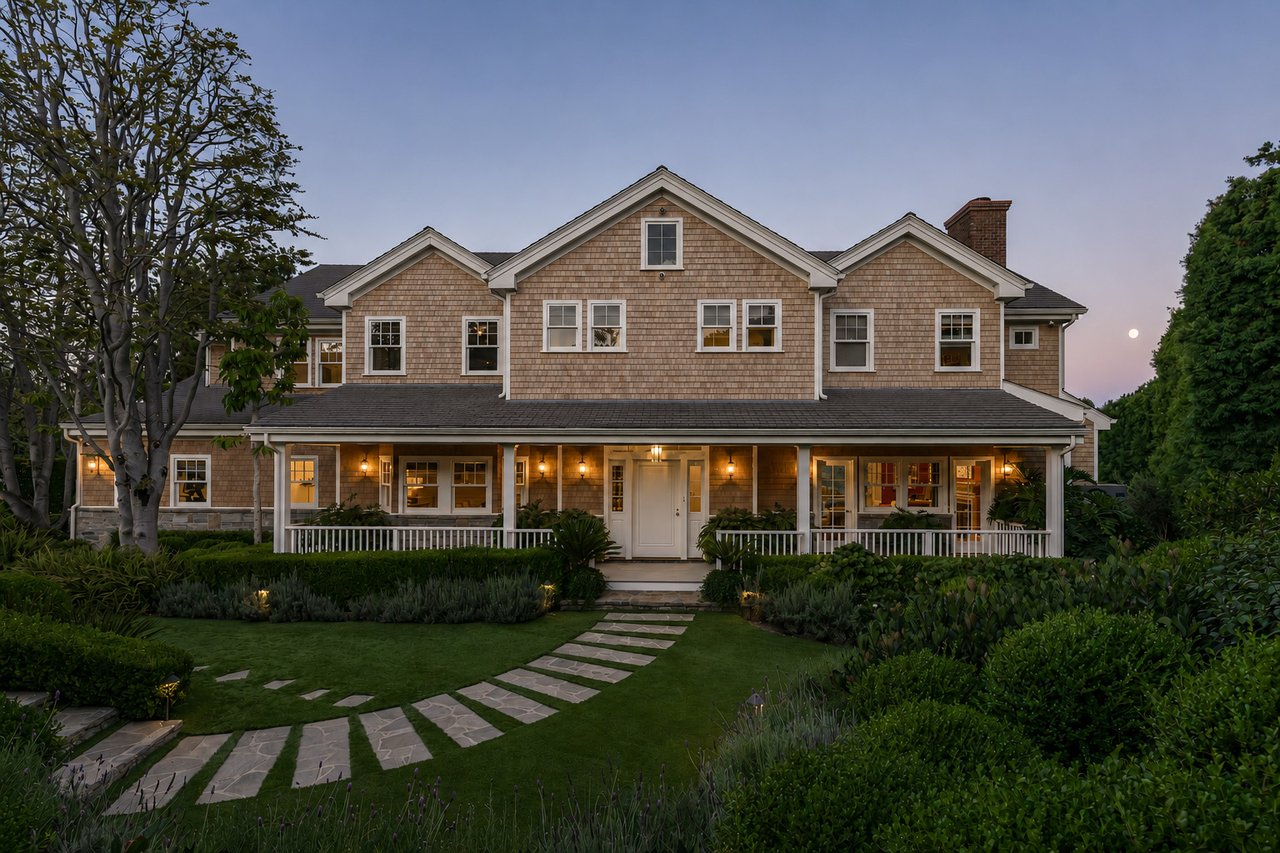
The Enduring Beauty of Shingle-Style Homes
Leonard Rabinowitz August 26, 2026
Leonard Rabinowitz August 26, 2026
By Leonard Rabinowitz
There is something immediately inviting about a beautifully designed Shingle-style home. The architecture can be grand without feeling imposing, sophisticated without appearing formal, and luxurious while retaining a warmth that many contemporary homes struggle to achieve.
Long associated with the great coastal houses of New England, Shingle-style architecture has found an equally natural home in Southern California. From Brentwood and Pacific Palisades to Santa Monica and Malibu, its relaxed elegance works remarkably well with the landscape and lifestyle of the Westside.
Shingle-style architecture emerged in America in the late 19th century, particularly in coastal communities. Rather than relying on elaborate ornamentation, these houses often use shingles to visually unite walls, rooflines, dormers, bays, and other architectural elements.
The result is architecture that feels almost sculpted rather than assembled.
Traditional examples frequently feature broad porches, sweeping rooflines, asymmetrical facades, generous windows, and rounded or turreted forms. Yet there is no single formula. Some are reminiscent of seaside cottages; others are substantial estates.
What connects the best examples is a sense of craftsmanship and informality.
Cedar is one of the great attractions of the style. New shingles can have rich honey and reddish-brown tones; over time, untreated cedar can weather into the soft silver-gray associated with classic coastal homes.
That natural aging gives a house something that cannot easily be manufactured: patina.
Unlike a perfectly uniform exterior, shingles create subtle variations in texture, shadow, and color. The house changes slightly with the light and continues to develop character as it ages.
For homeowners who prefer greater uniformity, shingles can also be stained or painted. Soft whites, grays and muted natural colors can preserve the architectural texture while producing a more contemporary appearance.
Perhaps the greatest strength of Shingle-style architecture is emotional rather than technical.
These homes tend to feel established—even when newly constructed.
In luxury real estate, size alone doesn't create a memorable house. Proportion, materials, landscaping, and architectural detail determine whether a large residence feels like a home or simply a large building.
Shingle architecture can be particularly successful at humanizing substantial square footage. Deep rooflines, porches, dormers, chimneys, and textured exterior surfaces visually break down the mass of a large residence.
The result can be both impressive and welcoming.
Although the style is closely identified with the East Coast, it translates beautifully to Southern California.
Our climate allows architects to take one of the traditional hallmarks of Shingle architecture—the porch—and expand the idea into terraces, loggias, outdoor living rooms, gardens, and pool areas.
Large windows and doors can connect traditionally inspired exteriors with bright, contemporary interiors. Mature landscaping softens the architecture further, particularly in neighborhoods such as Brentwood, Pacific Palisades, Santa Monica, and Malibu, where large lots and established trees provide an ideal setting.
The combination is particularly appealing: East Coast architectural character adapted to the California lifestyle.
Today's best Shingle-style houses aren't necessarily reproductions of homes built a century ago.
Architects are increasingly simplifying the vocabulary.
Ornate columns and extensive moldings can give way to cleaner lines. Dark steel or bronze-colored windows can provide contrast against natural cedar. Interiors may be decidedly contemporary, with open floor plans, large expanses of glass, and seamless connections to gardens and terraces.
That tension between old and new is part of what makes the architecture so interesting.
A house can acknowledge architectural history without being constrained by it.
Some architectural styles are closely associated with the decade in which they were built. Shingle-style homes have largely avoided that problem.
Part of the reason is the authenticity of the materials. Wood, stone, landscape, and natural light tend to become more beautiful—not less—as a property matures.
A well-designed Shingle home can therefore feel equally appropriate when newly completed and decades later.
For buyers of significant homes, that longevity matters. Architecture represents an enormous investment, and timeless design has an advantage that goes beyond fashion.
Luxury buyers increasingly encounter homes dominated by glass, steel, concrete, and highly minimalist interiors. At their best, those houses can be extraordinary.
But they aren't for everyone.
Shingle-style homes offer a very different expression of luxury: craftsmanship instead of minimalism, texture instead of austerity, and warmth instead of formality.
They can also accommodate the features today's buyers expect—large kitchens, expansive primary suites, gyms, theaters, wine rooms, home offices, pools, and extensive indoor-outdoor entertaining spaces—without sacrificing architectural character.
That combination helps explain why the style continues to endure.
Not at all. Although the architecture has strong coastal associations, it works beautifully in wooded, canyon, and estate settings as well. The natural materials allow the house to relate particularly well to mature landscaping.
Untreated cedar naturally weathers toward a silver-gray appearance. Homeowners can also stain, oil, or paint shingles when a different or more uniform appearance is desired.
Absolutely. Some of the most compelling contemporary examples combine traditional exterior materials with open floor plans, large windows, modern kitchens, and expansive indoor-outdoor spaces.
Examples can be found throughout Los Angeles' luxury neighborhoods, particularly in Brentwood, Pacific Palisades, Santa Monica, Malibu, and other areas where larger lots and mature landscaping complement the architecture.
Architectural fashions come and go, but the best Shingle-style homes have never depended on fashion.
Their appeal comes from something more fundamental: natural materials, beautiful proportions, craftsmanship, warmth, and a sense that a house belongs to its surroundings.
Modern architects may simplify the details and reinterpret the interiors, but the qualities that made these homes beautiful more than a century ago remain remarkably unchanged.
For me, that is the real appeal of Shingle-style architecture. A great Shingle home doesn't simply look luxurious. It looks like somewhere you want to live.
Stay up to date on the latest real estate trends.
A Guide to Timeless Design for Your Malibu Property.

A Luxury Builder's Guide to Creating the Perfect Wine Cellar in Your Home.

GIVE YOUR HOME THE CHRISTIE’S TOUCH
LeonardR Group, distinguished luminaries in the realm of real estate, boast an illustrious track record of orchestrating multimillion-dollar transactions in the opulent locales of Brentwood, Beverly Hills, Bel Air, and Malibu. Whether you aspire to buy or sell, rest assured that in their refined stewardship, you shall be endowed with unparalleled resources, consummate expertise, and a network of connections to secure the epitome of value.